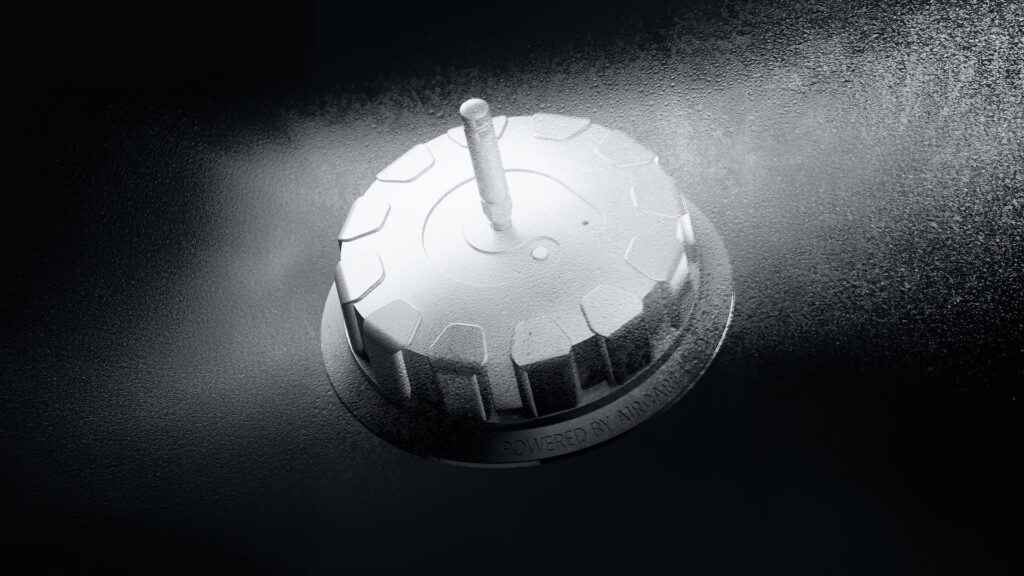
AirCare. Seeing What No Other Sensor Can.
AirCare remotely measures dust, grease, and temperature inside ductwork – helping businesses reduce fire risk, lower maintenance costs, and stay compliant with frameworks like BESA TR19® and BS EN 15780.
Accurately Measures Particle Buildup
Engineered to detect dust and grease buildup at micron-level precision, monitor critical temperature changes, and deliver real-time zone-based insights, AirCare transforms static ventilation systems into intelligent networks.
Micron Deposit Levels
Real-time tracking of dust and grease buildup inside ductwork, measured in microns (μm). Automatically alerts when TR19® thresholds are at risk of being exceeded, enabling action before it’s too late.
Temperature Readings
By identifying rising temperatures early, AirCare provides a first alert to potential fire risks, overheating, and system stress.
Zone-Based Monitoring
Visualise buildup by site, system and zones — enabling granular insight into contamination patterns and cleaning needs.
Next Cleans Due
AI-predicted cleaning dates based on historical buildup trends and usage – providing clients an intelligent, proactive maintenance roadmap.
- Precision MonitoringMeasures particle accumulation with micron-level accuracy to detect early signs of risk and non-compliance.
- Threshold IntelligenceAlerts when deposit levels approach TR19® fail limits, enabling proactive response before issues escalate.
Live Air Quality Insights
Detect issues as they emerge, optimise indoor conditions, and respond with targeted, data-driven action.

The Compliance Gap: Why Your Annual Inspection Isn’t Enough for Insurers
An annual ductwork inspection proves you were compliant for one day out of 365. For the other 364 days, you are operating in a data vacuum. In the eyes of modern insurance and the Building Safety Act, this compliance gap is your biggest liability.
In both the commercial kitchen and facilities sectors, the TR19® certificate has long been the gold standard.
You get the clean, you get the paperwork, and you file it away for the auditors. But there is a growing tension between paper compliance and real-world risk.
Insurers are no longer just asking if you cleaned your ducts. They are starting to ask how you managed the risk in the six months after the clean. Whether it’s combustible grease in an extract or particulate buildup in a supply line, if an incident occurs on day 180, a certificate from day 1 is no longer a ‘get out of jail free’ card.
The Problem with the ‘Snapshot’ Approach
The traditional model of air hygiene is built on snapshots. An engineer takes a manual micron reading, confirms the system is below the 200μm (grease) or 60μm (dust) threshold, and leaves.
The flaw is simple. Ductwork is a living environment. For kitchens, a change in menu or seasonal volume can accelerate grease buildup in weeks, not months.
For offices and healthcare, a surge in seasonal pollen can push a ventilation system into the Allergen Zone (>10μm) overnight, while building occupancy shifts can cause dust to accumulate far faster than a static schedule allows for.
Without continuous data, you are essentially guessing that your system is still compliant between visits.
Closing the Liability Loophole with AirCare
AirCare removes the compliance gap by providing what insurers now call ‘Live Risk Profiling.’ Instead of a single data point once a year, our patented sensors provide a continuous stream of evidence across your entire ventilation network.
By monitoring down to the micron, AirCare allows you to prove to insurers and stakeholders that you never crossed the danger zone:
- Verification of the Clean: Automated proof that your contractor reached the <50μm post-clean standard, regardless of whether it was a grease or dust extraction.
- Daily Compliance Logs: A digital ledger that proves your system levels remained within the TR19® limit every single day, providing the continuous evidence insurers now demand.
- The Intervention Point: You don’t clean because the calendar says so, you clean because the risk says so. CORE, AIRO’s monitoring dashboard, triggers an automated alert the moment your ventilation system reaches a 200µm average.
- Critical Hotspot Safeguards: Risk isn’t always uniform. If a single sensor detects a localised buildup exceeding 500µm, CORE flags the critical hotspot immediately. This ensures that a single high-risk area never goes unnoticed, even if the total system average appears to be within range. It is necessary to point out that hotspots must also be considered based on the level of risk posed. For example 500µm within the canopy, above the heat source would be a far higher risk than a small hotspot on a turning vane many meters away from the heat source.
From Due Diligence to Scientific Certainty
The Building Safety Act and evolving insurance requirements are moving toward a duty of care that requires building operators to be proactive, not reactive.
Providing an insurer with a live report of micron levels is a fundamentally different conversation than providing a dusty PDF from eight months ago. It shows that you aren’t just following a schedule, instead you are actively managing the threshold between safety and a flash point or hygiene failure.
A New Standard of Resilience
Real-time monitoring isn’t just about avoiding fires or dust-heavy air, it’s about protecting the ‘golden thread’ of your building’s history. It ensures that your compliance isn’t just a moment in time, but a continuous state of safety.
When you close the compliance gap, you don’t just reduce your insurance liability, you gain total control over your environment.
Is your safety record a continuous thread or a series of disconnected snapshots? It’s time to move beyond the certificate.